
Use Cases:
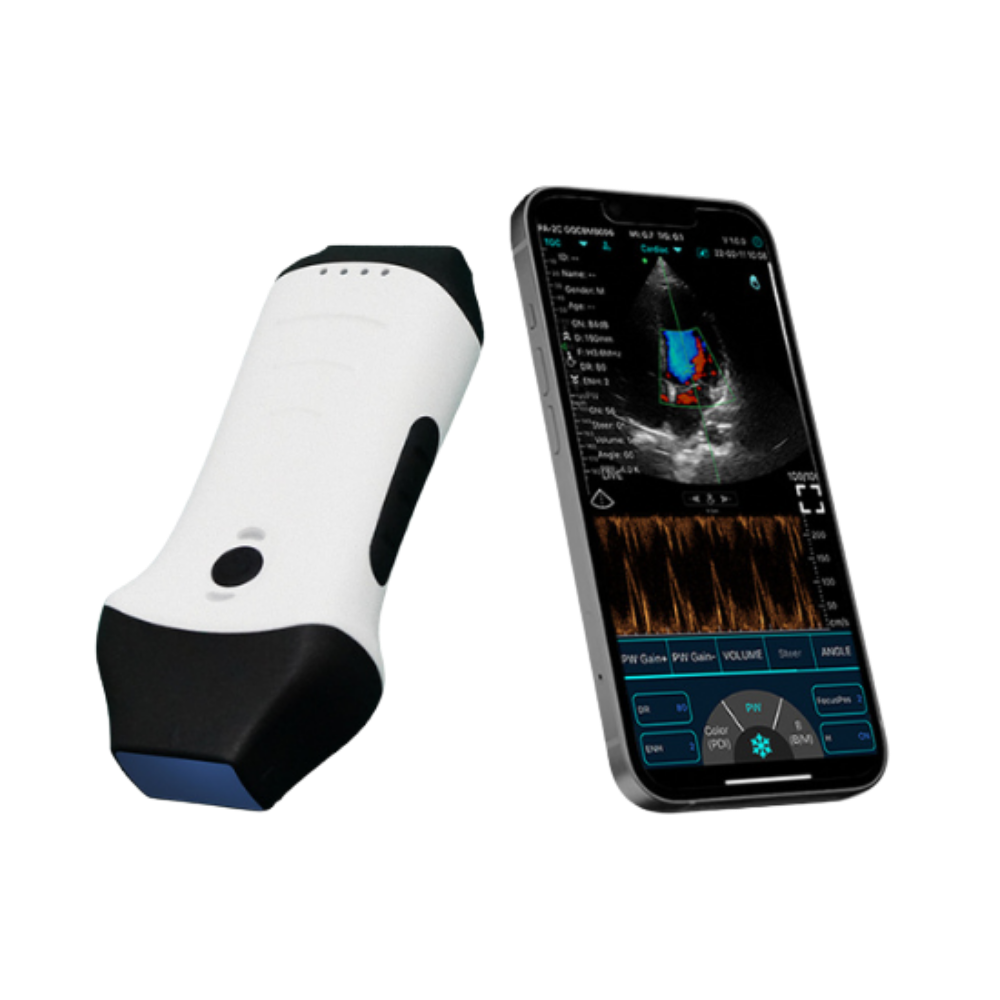
Dual-head Multipurpose Ultrasound Phased + Linear Probe
The Dual-Head Multipurpose Ultrasound Scanner (Phased + Linear) combines two of the most widely used ultrasound probe types into a single compact wireless device, providing exceptional flexibility for clinicians working across multiple specialties. By integrating a phased array probe for cardiac and thoracic imaging with a high-frequency linear probe for superficial structures and image-guided procedures, the scanner enables healthcare professionals to perform a broad range of examinations without changing equipment.
Designed for point-of-care ultrasound (POCUS), the scanner brings high-quality diagnostic imaging directly to the patient. Whether used in emergency departments, intensive care units, hospital wards, GP practices, community healthcare, physiotherapy clinics, or private practice, it supports rapid bedside assessments, informed clinical decision-making, and more efficient patient management. Its wireless portability also makes it an excellent solution for mobile healthcare teams, outreach services, and remote clinical environments where flexibility is essential.
The scanner incorporates advanced ultrasound technologies, including Colour Doppler, Power Doppler, and Pulsed Wave Doppler, enabling clinicians to assess both anatomical structures and blood flow with confidence. From focused cardiac assessments and lung examinations to vascular imaging, musculoskeletal evaluations, nerve imaging, thyroid scanning, and ultrasound-guided procedures, it offers a versatile platform that supports a wide range of everyday clinical applications.
Whether expanding your point-of-care ultrasound capability or equipping clinicians with a flexible multi-specialty imaging solution, the Dual-Head Multipurpose Ultrasound Scanner (Phased + Linear) delivers the versatility needed for modern healthcare. The following examples highlight some of the most common clinical applications for this scanner. Ultrasound should always be performed by appropriately trained clinicians and within their professional scope of practice.
1. Cardiac & Focused Heart Assessments
Use the phased array mode for focused cardiac scans, bedside heart assessments, and selected echocardiography views. Ideal for emergency medicine, acute care, anaesthesia, and point-of-care decision-making.
2. Chest & Lung Examinations
Suitable for rapid chest and lung scanning to support assessment of pleural fluid, lung sliding, and selected respiratory presentations in hospital, urgent care, or community settings.
3. Vascular Imaging & Blood Flow Assessment
Use the linear mode with Colour Doppler, PW, and PDI to assess superficial vessels, carotid structures, venous access, circulation, and blood flow patterns.
4. Musculoskeletal (MSK) Imaging
Ideal for examining muscles, tendons, ligaments, joints, bursae, and soft tissue injuries. Useful for physiotherapy, sports medicine, orthopaedics, rehabilitation, and pain clinics.
5. Guided Injections & Procedures
Supports real-time needle guidance for joint injections, tendon sheath procedures, nerve blocks, vascular access, and pain management interventions.
6. Nerve Imaging & Regional Anaesthesia
Helps visualise superficial nerves and surrounding anatomy for nerve blocks, regional anaesthesia, and image-guided pain procedures.
7. Thyroid, Breast & Small Parts Imaging
Use the linear probe mode for thyroid scanning, breast tissue assessments, lymph nodes, and other superficial structures requiring higher detail imaging.
8. Emergency & Bedside Point-of-Care Ultrasound (POCUS)
Portable design makes it ideal for emergency departments, ambulances, wards, ICU, and bedside rapid assessments where immediate imaging supports faster decisions.
9. Community & Mobile Healthcare
Wireless portability allows clinicians to perform scans in care homes, community clinics, remote settings, and home visits without bulky equipment.
10. Education & Training
Excellent for teaching cardiac basics, vascular access, ultrasound-guided procedures, anatomy, and multi-specialty scanning in universities and training centres.
ABOUT US
Oras Medical is a specialist clinical adoption provider helping professionals, clinics, hospitals, GPs and care teams implement portable medical ultrasound solutions across the UK.
Oras Medical is a trading name of Oras Marketing Limited, Registered in England & Wales with registration number 12935403. VAT No. GB498618427. Registered address: Eastlands Court Business Centre, St. Peters Road, Rugby, Warwickshire, CV21 3QP. Email: admin@orasmedical.com, Phone: +44 (0) 1788 270 191.
SOLUTIONS
PRODUCTS
USEFUL INFO
PAYMENT INFO

Copyright 2026 Oras Medical - Privacy policy | Terms & Conditions | Disclaimer